


The Difficult Research Support Network
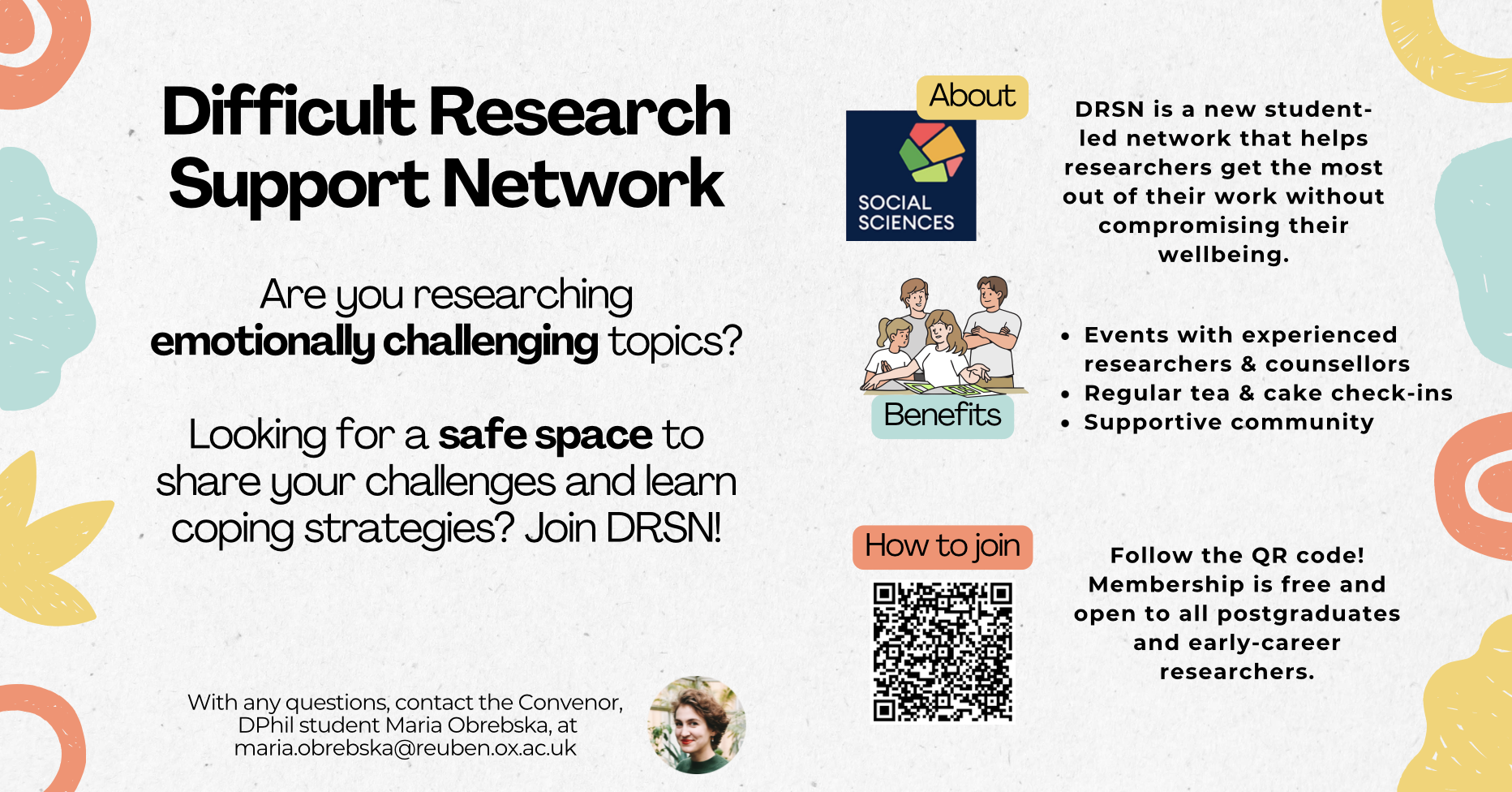
The Difficult Research Support Network (DRSN) is a student-led community within the Social Sciences Division, launched last year to help researchers maximise the potential of their work while safeguarding their wellbeing.
Many researchers struggle with working hours that don't follow clear schedules. Knowing when to stop - or how to rest - can feel especially hard when there's no clear boundary of a 9-5 working day or 'annual leave', and when the work is tied to questions that personally matter to you.
In this session, we'll discuss:
- Why research doesn't map onto a 9-5 model - and the costs of pretending it does
- How overwork emerges when work has no clear edges
- What 'time off' can mean when annual leave doesn't capture how research actually works
- How to understand our own rhythms without turning them into productivity hacks
This is not a session about fixing yourself or working more efficiently. Instead, it offers a caring space for shared reflection, honesty, and mutual support around the realities of difficult research.
Join us to share perspectives, connect with peers, and shape a supportive research community across the Social Sciences!
Find out more about the Difficult Research Support Network and other events click here
Please see our booking Terms and Conditions below
The Convener

Other Divisional Events






Researcher Development Terms and Conditions
In booking any training workshops, you agree that:
COMMITMENT: application is not an expression of interest; it is a firm commitment. You will be available for the full duration of the course session(s); if you are not, please do not make a booking. You will not accept any subsequent meeting invitations that may fall during the given workshop times.
PRE-WORK / HOMEWORK: if applicable, you will complete any given pre-work and/or homework as described on the workshop web listing, as it constitutes part of the workshop
CANCELLATION: should your circumstances change, and you are not able to attend the full session(s). you will cancel giving at least 72-hours' notice, so we can offer the place to someone on the waiting list.
ARRIVAL: you will join, or arrive at, the workshop 5 minutes before the advertised start time, to ensure a prompt start.
LATE POLICY: you understand that the online room will be locked / workshop door will be closed 10 minutes after the event start time and late-comers will not be admitted. This is to preserve the integrity of the course for those who are present.
ENGAGEMENT: you will give the session your undivided attention and engagement. You will not be able to do other tasks in parallel. If online, you will ensure that your environment and internet connection allow you to participate verbally and with video cameras on. These are interactive workshops, and it is not appropriate to attend from a silent or shared workspace.
ATTENDANCE RECORD: you understand the Register will be taken in the last half-hour of the course, and anyone not present in the room at that point will be marked as non -attending (see below)
FEEDBACK: you will contribute feedback afterwards, to help us understand how well the session met its intended aims, and facilitate our continuous improvement
CONSEQUENCES OF NON-ATTENDANCE: you understand that any non-attendance
a) is visible to departments and supervisors/PIs, and
b) may result in any future bookings you've made within the same term being cancelled, and the place(s) offered to the waiting list.